
Malcolm Stands Alone
When sheep invoke the legacy of a lion.

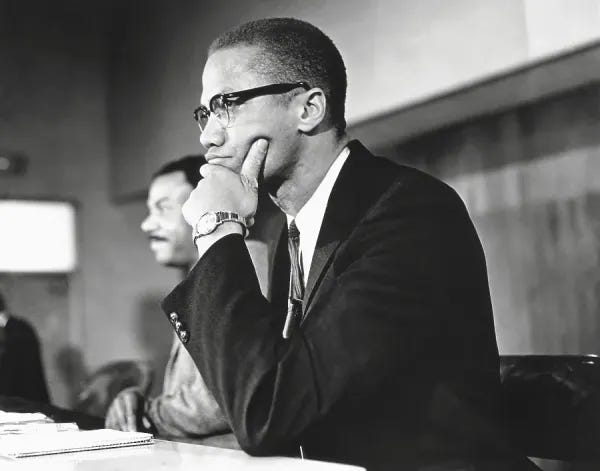
“You can’t make a wise man a slave, you can’t make a warrior a slave. When you and I came here, or rather when we were brought here, we were brought here from a society that was highly civilized, our culture was at the highest level, we were warriors—we knew no fear. How could they make us slaves?” — Al Hajj Malik/Malcolm X
"Malcolm has always had a feeling that his life would end by violence. This does not trouble him.” - Alex Haley
Until school and mosque and minaret get torn down, only then dervishes can begin their community. Not until faithfulness turns to betrayal, and betrayal into trust, can any human being, become part of the truth. - Mawlana Rumi (via Zienab A.)
Born on May 19, 1925, Malcolm would have been 101 years old if he were alive today.
With his birthday coming up, many will likely write tributes to invoke the great American shahīd, and laud his bravery, boldness, conviction and vision.
But let us be honest. How many of his admirers truly choose to walk Malcolm’s footsteps of sacrificing comfort, radical honesty and speaking truth to power?
How many dare to tread the path he blazed of warrior-hood, over the path of indentured slavery to respectability/upward mobility/access/sounding diplomatic/self interest?
The truth is, Malcolm would probably have had very few friends in the mainstream Muslim community today.
He would have found them too meek and too mealy mouthed in confronting tyranny and the wolves in sheep’s clothing in our midst. He likely would have thought them to be too insular, too ethnocentric, too legalistic and rigid, and more concerned with securing social advantage than their responsibilities towards the ummah.
He would have likely thought most Muslim boards/institutions/scholars/mosques as too captured by assimilationist mindsets, indifferent to the spiritual and political rot that festers beneath the facade of perfectionist piety.
He likely would not have found affinity with the “celebrity shaykhs” but with those unseen soldiers in the margins, the few, true invisible actors selflessly committed to empanaciparoty justice for African Americans, Muslims and all people in the least glamorous and unlikeliest of places.
And the truth is, this lack of love would have likely been reciprocal.
Malcolm would likely not be found “orthodox” enough for the speaker circuit, too radical for professional crowds. His lack of “ijazas” and fiery tone would have unsettled most suburban masjid boards.
Because this was true even in his own lifetime. People who encountered him described him as intimidating, dangerous even. How could he not be, for he became a free, sovereign man in every sense of the word: intellectually sharp, morally uncompromising, intensely disciplined, and most of all, very difficult to manipulate.
Just like Umar bin al-Khattab’s mere presence was enough to have the devil flee from his path, so too would many flee from the unsettling prescriptions of truth that Malcolm medicinally offered uncompromisingly.
If he were among us today, many would have turned away from the hard inner work that his example demanded. They would have likely fled from the disinfectant qualities of the sunlight of the truth he spoke, preferring instead the comfortable shadows of fake smiles, pretense and keeping up appearances.
Because it is a principle universally acknowledged that the truth and its lonely emissaries have few friends.
African American journalist Gil Noble admitted that he was “put off” by Malcolm X at the time. He found his message was “too blunt” and “dangerous.” Noble described how Malcolm was unsettling because he did not seem to care for the era’s social pressures that trained people not to confront issues directly. He confessed that people only saw his true worth and celebrated him after his death. Noble’s reflection is unsurprising, and captures the enigma that is Malcolm X: admired, feared, projected unto, but relatively few could fully accompany him.
“They press their fingers into their ears, cover themselves with their clothes, persist in denial” (Qur’an 71:7)
We so easily invoke Malcolm, but we do not often acknowledge that he lived a very lonesome life. Not simply due to the many thankless battles he waged, but because his very presence exposed collective and individual compromise, cowardice, dependency, and moral sleepwalking.
He was repulsed by the idea of the oppressed walking around hunched over, afraid of the light of their own power, histories, vernacular and scripture.
He detested the stench of fear on his people. He was against “straight-jacketed thinking, and straight-jacketed societies.”
He inhabited a different realm than most, because indifference to injustice was simply an impossibility for him.
In a previous, viral previous post, I wrote of the continuous life of Malcolm:

“When Malcolm moved in the world, it is important to remember that he foresaw his death. He spoke and acted like a man who was dead—a shahid (a martyr)—already:
I’m a man who believes that I died 20 years ago. And I live like a man who is dead already. I have no fear whatsoever of anybody or anything.
In essence, Malcolm still lives: martyrs don’t die. He fulfilled the prophetic injunction of Prophet Muhammad ﷺ who advised: “die before you die.” He—like the people of Palestine—embody the shahada (witnessing) of la ilaha illa Allah, Muhammad Rasul Allah. That there is nothing in this world truly worthy of worship other than the One. Embodying the shahada in action offers a model of what true, transformative tawhid (Oneness) can do in the world: it can outlast all tyrants.”
Malcolm inculcated lived, activated tawhid, because the reality of death—and thus, eternal life—hung over him always. In that sense, he put this wretched dunya it is rightful place, in his back pocket, never neglecting it, tending to it only as a means to an end: cultivating a life rife with sweet existential truth and purpose.
He lived as all of us should: a gharib, as a stranger, per the Prophet Muhammad’s injunction: “be in this world like a traveler or a stranger,” and “Islam began as something strange, and it will return to being strange as it began, so glad tidings (tuba) are for the strangers.”
Rather than pass on the bitter tonic of estrangement, it quenched him, preferring it over the honeyed, soothing elixir of denial, assimilation and pretense.
He extracted himself spiritually and mentally from the idolatrous clasps of convention. First, from mainstream America, then eventually from parts of the Nation, and many times, he extracted himself from relationships with former “friends” who feared the consequences of his searing clarity.
He likely would have walked away from the herd of immigrant “mega church-style Islam,” and would have found it closer to the vestiges of the slavery-inherited Christianity that he converted away from.
He stripped himself of so many delusions and shattered so many idols that he found himself alone with the Alone, standing atop a mountain of truth in a profoundly isolated place.
On this summit, however, he could take solace being in the company of an legion of honor: past, present, and future revolutionaries, messengers, and freedom fighters who likewise stood apart from their age. Of course, it must be said that Malcolm was not a standalone man. He was supported and nurtured by matriarchs, workers, intellectuals and brothers alongside him the 20th century Black Radical Tradition movement and cultivated important friendships and networks locally and internationally with Muslim and Pan-African leaders. He was supported, uplifted and loved by many in his age.
But the reality is, in every age, there are some who fight, and some who don’t. Not all people are destined for the fighting life. Today, some communities are confronting state violence with their bodies head-on—from protests in Minnesota to the resistance in Gaza—while others retreat into curated comforts: matcha lattes, Dubai chocolate, suhur fests, and the perpetual planning of the next vacation or even the next ʿumrah, unperturbed by the suffering unfolding around them.
Similarly, it must have been bitterly estranging for Prophet Yusuf to know that the people of ancient Egypt ate, drank, and continued on with their merry lives while the languished in prison, betrayed by his brothers.
The early sage Al-Hasan al-Basri, hunted by Al-Hajjaj ibn Yusuf, must have felt the pangs of painful isolation knowing that the people of Basra lived resumed their life while he was denied even the dignity of leaving imprisonment to bury his daughter and pray over her.
And the people of Baghdad laughed, lived and played with their children while the jurist Ahmad ibn Hanbal was transferred from one prison to another and from one torturer to another. Likewise, most Muslims of their era likely resumed their mundane lives while figures like Ibn al-Jawzi, Malik ibn Anas, Abu Hanifa were imprisoned, flogged, sometimes until their shoulders were dislocated, or until their bodies grew frail and sick.
Such is the high price of reneging a life of dwarfdom. The price of escaping the herd.
Such is the price of a life ornamented with dignity, and the honored, inner posture of true mental and spiritual freedom.
It behooves us to articulate that most people are simply unwilling to pay it. In every age, estrangement is the bosom friend of those who elect to undertake existential struggles for dignity, freedom and justice while others remain content with conformity.
But what many miss is that the alienation born out of stubborn steadfastness is among the highest acts of worship and crowning testaments of what it means to be Muslim, to be human.
Because the unseen reality of estranged individuals is that they are not marginal to society; quite the contrary, they are its unknown axial poles. Its awtād—the pegs upon which Allah deputizes for truth and justice to be firmly fastened, even as the world mistakes them for pariahs.
The estrangement feels thankless in the interim, but it is rewarded handsomely in the court of celestial reckoning: the court that ultimately matters most.
There, in the celestial court, there is no people pleasing, no institution worship, no weak excuses, no lies. There is only the liberating, final, all-encompassing light of Divine justice and truth, before which tyranny is incinerated and every illusion laid bare.
One would think, that in this age of live-streamed genocidal dystopia, the only natural response would seem to be for a million Malcolm Xs rising from the ashes of fury. Yet instead, we are somehow met with deeper defeatism, greater meekness, and an almost unnatural capitulation to power. His lonely legacy—of moral clarity, courage, and uncompromising dignity—feels painfully absent now more than ever.
Millions are more sedated than ever, resigned to the inevitability of the status quo while their brethren taste blood in their mouths, fighting for a more dignified existence. Some, as this Substack has previously shown, even use Islam’s supposed canonical legal pragmatism as a fig leaf for their perpetual cowardice.
This sharp contrast—between the sheep and the lions—is natural, cyclical. It is archetypal. It is cosmic code. It is an eternal reminder that if the trustees of the Divine message do not feel alone in this world, they are not doing it right, for estrangement from the world is the way of wilāya (sainthood).
In the scarcely trodden, lonesome fight for justice, the inverse of solitude is a ‘urs (wedding) in the unseen. It is a Divine effusion that few are honored to taste.
It is an āya for the weary seeker and the lone fighters in this bitter moment, Allah suffices as walī—as closest protector and companion—when most of creation has withdrawn or turned away.
For it is He who disciplines the souls of believers, purifying their hearts from fickle, worldly mirages. It is He who poured upon Malcolm and other fearless shuhada intimate knowledge and careful, Divine nurturing.
Even if only a few pure, fearless hearts remain on this oft-untrodden path, they suffice as shining emissaries for the truth.
The rarer they are in any society, the more sacred they are in the eyes of God, the more effective their transformative fury.
Malcolm’s lonely legacy reminds us what Islam in America—and indeed in the world—could look like, led from the soul, instead of the ego. Away from identity politics, performative piety and reactionary calculus. We need this model now, more than ever, for its all its blistering, fearless, universal, uniting urgency and potential.
Marking Malcolm’s 101th birthday, let us pay tribute to the high price he paid of estrangement (ghurba) in the dunya in his struggle against supremacists and cowardly “friends.”
A prince so high, it cost him to die at the altar of himself, so that we could inherit a timeless legacy of courage, looming over our little coddled, afraid selves.
Though we can never fully repay this gift, we must strive towards inculcating but some of his radical honesty, searing introspection and vulnerable humility. If he were alive, would we also find Malcolm “too blunt and dangerous” and lionize him after it is too late? Or would we truly take a fearless stand along with him?
May his example and memory be a balm for the estranged, and a reckoning for decaying, denialist Muslim institutions that are complicit in perpetuating moral rot and injustice.
We are missing your dignified scent and lone example, Hajj. Happy celestial birthday.