

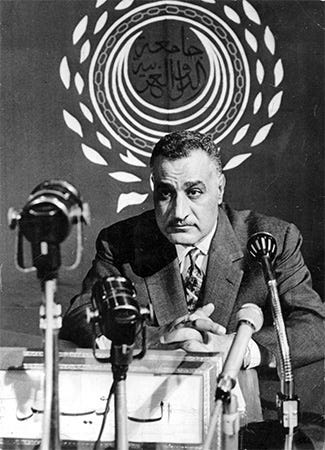
On the night of October 26th, 1954, Gamal Abdel Nasser stood in Alexandria’s Manshiya Square to celebrate the treaty that would end British military occupation. A man named Mahmoud Abdel Latif fired eight shots at him and missed every shot.
Despite the bullets, Nasser kept speaking, and the radio carried his defiance across the Arab world. Within days, the government dissolved the Muslim Brotherhood, and six of its senior leaders were hung in December that same year.
The details of that attempted murder plot remain shrouded in mystery.
Hasan al-Tohami, an Egyptian intelligence official close to Nasser and Sadat, admitted later in life that he and Nasser had close ties to Cairo-based CIA operative Miles Copeland, and that the Alexandria Manshiya assassination attempt was "suggested" by him to cement the legendary popularity of Nasser.
The story of the Muslim Brotherhood is a much more complex story than the one told by the security state apparatus. Rather than an “extremist ideology,” it began as an organic, natural reaction to the cessation of Muslim political sovereignty. It saw itself as a grassroots effort towards the restoration of a unified Muslim consciousness in a brave new secular age, as it was founded only 4 years after the fall of the Ottoman Caliphate in 1928 by Hassan al-Banna in Ismailia, Egypt.
For the three decades that followed, its sharpest public expression was military resistance to foreign colonial occupation. They sent thousands of volunteer fighters in 1948 to fight British and Zionist gangs in Palestine, and landed a blow to British military occupation in the Suez Canal in the 50s.
Initially, the Muslim Brotherhood didn’t pose an adversarial threat to Nasser.
In fact, they began as close allies. Nasser, the Free Officers and the Muslim Brotherhood worked together to overthrow the British-backed rule of King Farouq. When he founded the Republic, Nasser turned on the Ikhwan and quickly consolidated power for himself, commanding severe crackdowns, arrests, and the outright banning of the Brotherhood following the alleged 1954 assassination attempt in Alexandria.
The theatrics of that day made him an Arab nationalist icon. More than this, it arguably set into stone the logic of the Arab state security apparatus as being existentially in a state of war with “Islamic” political factions.
It fixed into the imagination of the public that iterations of Islam + politics are automatically illegitimate and dangerous under the nationalist gaze. It cemented the idea that the “Islamic threat” is a natural fixture of the secular, “postcolonial” world order.
But that founding myth didn’t even begin with Nasser: it began under the blessings of the monarchy of King Farouq. In December 1948, Prime Minister al-Nuqrashi issued the first formal, nationwide ban and state dissolution of the Muslim Brotherhood in Egypt.
The date is important, as this ban took place while Muslim Brotherhood volunteers were fighting in Palestine, and it happened at the urging of the British.
Hold that scene in your mind, because it is the origin story of a fear as global and as pervasive as air itself.
Of course, the pervasive secular tyranny that plagued the Arab world in Farouq and Nasser’s eras (and arguably even before) was borrowed by osmosis from Western and Soviet models. It wasn’t purely a product of Arab monarchies or republics, which inherited colonially constructed structures and anti-Muslim animus, so the logic of the colonial patrons and neo/post-colonial states became mutually reinforcing.
This toxic symbiotic relationship animates world politics today. Trump and co’s contemporary flavor of anti-Muslim hysterics—this time over “the Muslim Brotherhood”—is usually approached through the lens of an American story, informed by mainly the leftovers of 9/11, “War on Terror” rhetoric. As simply a symptom of the xenophobic, conservative movement hunting for an enemy within.
What often gets left out of the story is that this hysteria over the Muslim Brotherhood is not organic to America, it was imported. Fears of the Muslim Brotherhood were manufactured first in Arab capitals by monarchs and secular nationalist rulers who needed (and still subsist on needing) an enemy that would justify their dungeons, their security coordination with Israel, their repressive military, tribal and security apparatus, and crushing persecution against dissent.
They helped build the very same ecosystem that allows Trump, for example, to mock the honored Prophet’s name in his rallies undeterred without receiving a measly word of condemnation from any Muslim leader. Worse, they still fill his coffers with cash.
The narrative of American and Western Islamophobia often leaves out the fact that Arab states (and by extension, the readily complaint Muslim Zionist Uncle Toms) have always colluded with colonial aims and narratives, helping bolster the aims Greater Israel Project—which subsists on fueling Islamophobia as an existential necessity. After all, both Arab states and Israel share the same enemy: sovereign Muslim political imaginaries.
A complicated leader
It will surely be difficult for some to accept the proposition that the beloved anti-colonial icon, Nasser, helped legitimate the destructive modern day, ongoing “War of Terror” that is ravaging Muslim majority communities from Gaza to Sudan to Yemen to Iran.
Nasser was arguably the most charismatic, consequential anti-colonial leader of his century in the Arab world. For several years, Nasser was the only leader providing weaponry and support for the Algerian revolution, supplying it with a radio voice, a rear base and arms. The FLN would likely not have prevailed without that backing.
But his internal repression and fear of political Islam turned out to be his Achilles heel. It turned him from potentially being a genuine liberator into a harsh tyrant. Even though he once worked with them to overthrow the British and the monarchy, Nasser saw the Brotherhood as a rival for the loyalty over the hearts of ordinary people. He feared it, and perhaps was even intensely jealous of it.
Whether he intended it or not, Nasser (and other Arab leaders lauded as nationalist “heroes” of the independence era) are equally guilty of establishing the boogeyman that made the category of Islamic synonymous with enemy of the state for generations to come.
It is not a novelty of the dirty world of politics, of course, that the label “dangerous” is simply universally expedient. “Terrorist” or “dangerous” is conveniently tacked on to whomever the movement needs to be dangerous at any given moment, but in this case, this rhetoric is directly responsible for burying the Palestinian cause.

The Modern Day Inheritors
This toxic symbiotic relationship has reverberated into much more crushing and vicious version of secular state terrorism driven by anti-Palestinian/anti-Muslim political expression that exists today.
It took a turn for the worse after the Arab Spring. In August 2013, after the Egyptian military removed Egypt’s elected president Mohamed Morsi, they cleared the Raba’a al-Adawiya sit-in in Cairo, slaughtering in cold blood at least 3,500 of their fellow countrymen. It was right after the Raba’a massacre that the UAE and Saudi both declared the Muslim Brotherhood a terrorist organization in 2014. UAE-backed Haftar’s Libya followed suit in 2019.
Not far from Egypt is the current Gaza genocide. It is arguably the largest campaign of collective punishment of Muslim political agency in modern history, making it the most jarring, treasonous Arab betrayal of Palestine which began well over a century ago.

Today, in the current hellscape of genocidal dystopia and pervasive anti-Muslim hysterics, it is the UAE that is the leader of this wicked template.
It provides a steady supply of bribes, oil, cash, and security coordination. It even funds espionage against Muslims in the West, with surfacing reports that it plotted assassination attempts of Muslim leaders in the UK.
It bears remembering that, it wasn’t Obama that designated CAIR, MAS and Islamic Relief as “terrorist organizations”, it was the UAE that did so in 2014.
This relationship between Gulf authoritarianism shaping anti-Muslim currents in American politics deserves renewed scrutiny in light of Matthew Cole’s damning new book, Princes and Thieves: Jared Kushner and Mohamed bin Zayed’s Secret Plot to Remake the Middle East.
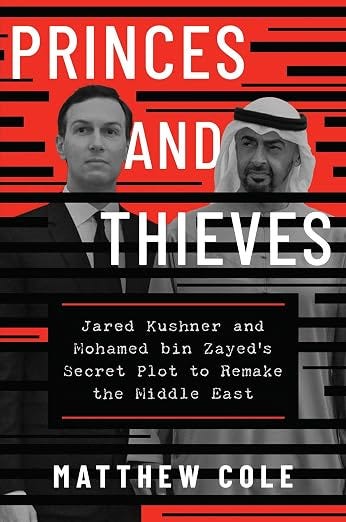
Cole examines the jarring and grotesque financial and political arrangements linking MBZ, MBS and Jared Kushner, and their tripartite wicked efforts to shape the Trump administration’s Middle East agenda and bend it to the will of Israeli expansionism, normalization and criminalizing indigenous resistance of native Muslims and Christians in Palestine.
As the Palestinian cause and support for resistance in Gaza gained more and more traction worldwide, it took another eleven years, in January 2026—three years into the Gaza genocide— for the State and Treasury departments to designate the Brotherhood’s Lebanese, Jordanian and Egyptian chapters of the MB as “terrorists” and of course, the Arab states ran with this measure and enforced it domestically.
The UAE is so extremist in its witch-hunt of Palestinian and Muslim political sovereignty that it lobbied to designate the Muslim Brotherhood a terrorist organization at the height of the Palestinian genocide. The US buckled to their demands.
Cole’s book shows how MBZ and MBS played a massive, well-documented role in getting Rex Tillerson fired, the person who was against the extremist measure and sounded the alarm against designating the Muslim Brotherhood.
In their role as Tel Aviv’s Arab counterparts, crushing the Palestinian cause became Abu Dhabi’s top priority, so the Emirates became the pipeline for funding anti-Muslim vitriol worldwide.
This confirms in searing clarity, of course, that the Islamophobia industry in America was always anti-Palestinian to the core.
Part of this agenda explains why they recruited American Muslim scholars to serve at the pleasure of UAE Fatwa Council while also serving on Trump’s “Religious Freedom” committee, and it helps explain why they have been shamelessly mum about the Gaza genocide.
So, as we decry Islamophobia and anti-Muslim mass violence, we must also include Arab leaders and complicit Muslim scholars who view any sovereign Muslim political expression as a threat to be liquidated, which in turn foments anti-Muslim sentiment, and legitimizes anti-Muslim animus, pogroms and genocides that have taken root globally.
Iran and Sectarianism
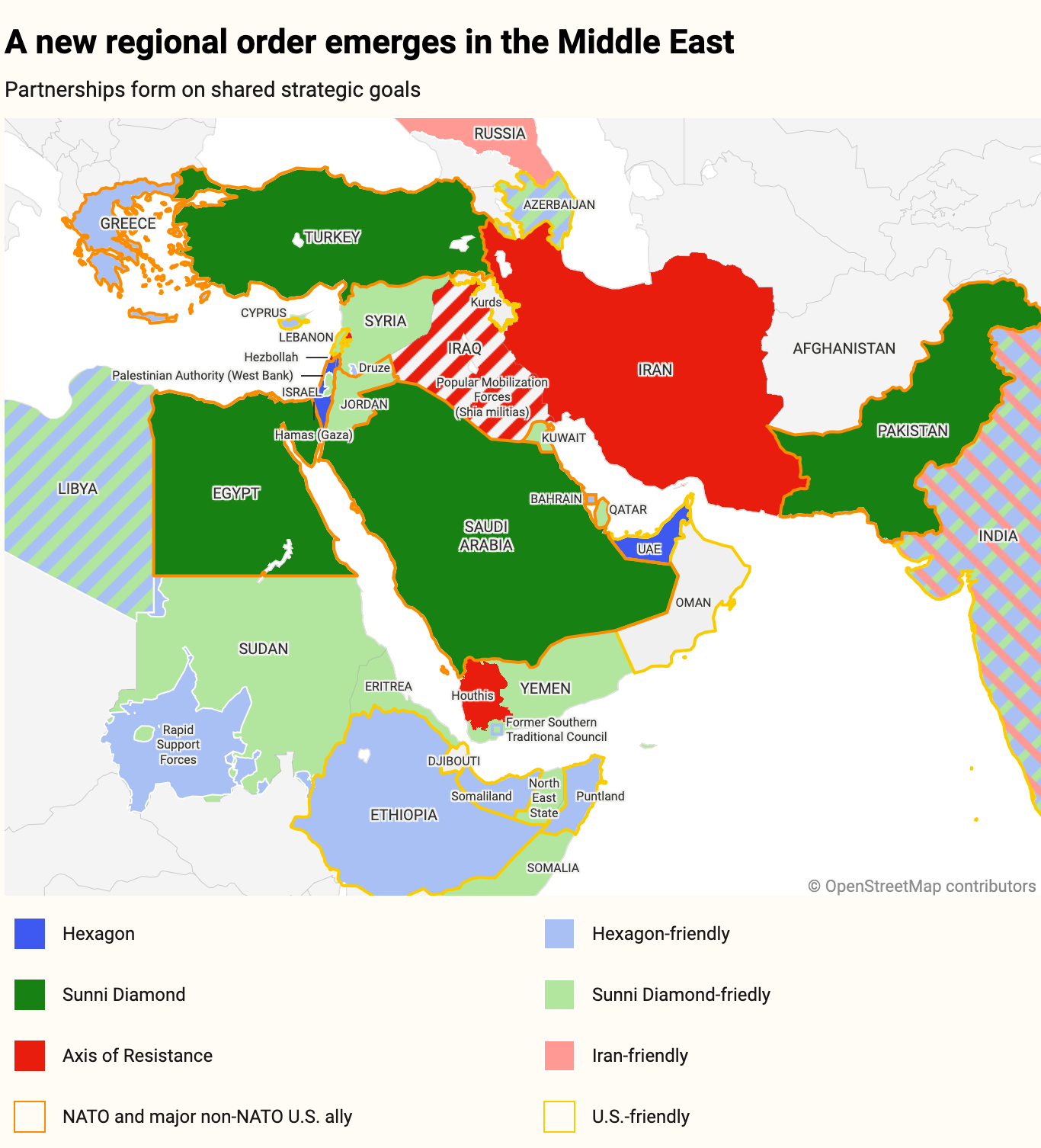
These same fears can also be traced back to the Iranian Revolution in ‘79, of course. Recent warmongering against Iran can also be partly traced to an Arab capital: Amman, home of the Hashemite military subcontractor whose most recent hobby is shooting down Iranian missiles headed to Tel Aviv and bombing children in Syria.
In December 2004, as Iraq headed toward elections, King Abdullah of Jordan warned the Washington Post that a new “crescent” of Shi’a power could stretch from Iran through Iraq, Syria and Lebanon. The phrase “Shi’a crescent” can be traced to that interview, and was given a few weeks before Iraq’s first parliamentary elections. It was addressed to Washington, and framed Iran as a singular danger to “U.S. interests and allies.”
The “Shi’i threat” gave Arab governments a seat at the coveted table with American strategists, who legitimized the cause of fighting cartoonishly “evil Muslims” in a way that was expected of them. This narrative handed Israel’s most hawkish defenders a convenient roadmap by which Iran, Hezbollah and every other source of resistance to Israeli expansionism sat on a single, single hostile axis.
The past century or more of humiliation has seen Arab states adopt as policy the inversion of the Qur’anic verse: “Muhammad is the Messenger of Allah; and those with him are resolute against the disbelievers, merciful among themselves.” In this immoral, systemic inversion, the harsher they are towards the believers to placate the demands of Pax Judaica, and the more merciful and compliant they are to the killers, the better.
What the fear is actually about
To summarize, “The Muslim Brotherhood” began as a vast and varied natural Muslim disposition that defies generalization. Criminalizing it is a stand in for criminalizing any form of Muslim political agency that resists neoliberal hegemony. “The Muslim Brotherhood” has included many iterations, ideas, individuals, political actors, charity networks, doctors and syndicates, that it defies categorization altogether.
Efforts to ban it from 1948 in Egypt, to 2014 in the UAE and Saudi, and today in America, all point to by-and-large one trigger: the Palestinian struggle for freedom which is both universal and Islamic in essence—making a “free Palestine” the ultimate death knell to this symbiotic relationship.
So next time you hear the Muslim Brotherhood “accusation”, ask yourself what secular tyranny, disproportionate power dynamics and decades of treason and pernicious politics exist behind it. I look forward to the day when Muslim politicians provocatively answer “so what if I were?” rather than defensively “dodge” the question like it is some kind of insult for shock and awe effect, to disarm the dominant narrative that Muslims in politics must exist only under the terms of the dictates of the neoliberal order.
We must be able to interrogate the deeper question at hand that underlies this slow death of the “ruse based” dis-order: who gets to say what a Muslim may or may not do politically?
A sovereign Muslim political order—one that is accountable to its own references, that builds institutions without hungering for external approval, and that does not treat normalization with Israel as a precondition for legitimacy—is precisely the thing that frightens panicked tyrants.
It also frightens their patrons, because it would be a political actor whose policies they cannot abuse, control or own. The “Brotherhood” label is thus shorthand for that alternative moral universe.
The “terror” designation allows a state to smear any rival, close any charity (like the Holy Land Foundation), and justify the worst alliances, all while the state has the monopoly on religious discourse that blesses Judeo-Christian violence.
This is the textbook definition of fasad fil ard (corruption of the earth), fitna (strife) of Pharaoh-like injustice and it is the natural duty of every Muslim to resist it, regardless of what name or form that resistance takes.
The charges of “Islamic terrorism” or “Muslim Brotherhood” have become such empty words. That is all they ultimately are. Smoke. Mirrors. Words. Words manufactured in the backstage of a hypocritical, afraid, decaying genocidal political theater.
It is an empty accusation that is supposed to somehow cover accusations against a registered charity in Dearborn, or brave, anti-genocide student activists in London, or a political party that has fairly won an election.
The good thing about this “accusation” is its ontological weakness: when a label can be stretched to describe a woman in a hijab, a ballot box and an assault rifle alike, it is rendered useless, collapsing under the weight of its own fear and incoherence. A meaningless mirage of lies.
In this open season of anti-Muslim hate globally, remember that you have Muslim and Arab governments to thank for being steady partners in the systemic war on Islam and Muslims.
But the good news is that symbiotic relationships are mutually destructive: organisms that have built one another into existence, depend on the other's survival.
Who’s afraid of the Muslim Brotherhood?
Mostly, it is those who are afraid for their own continued existence.